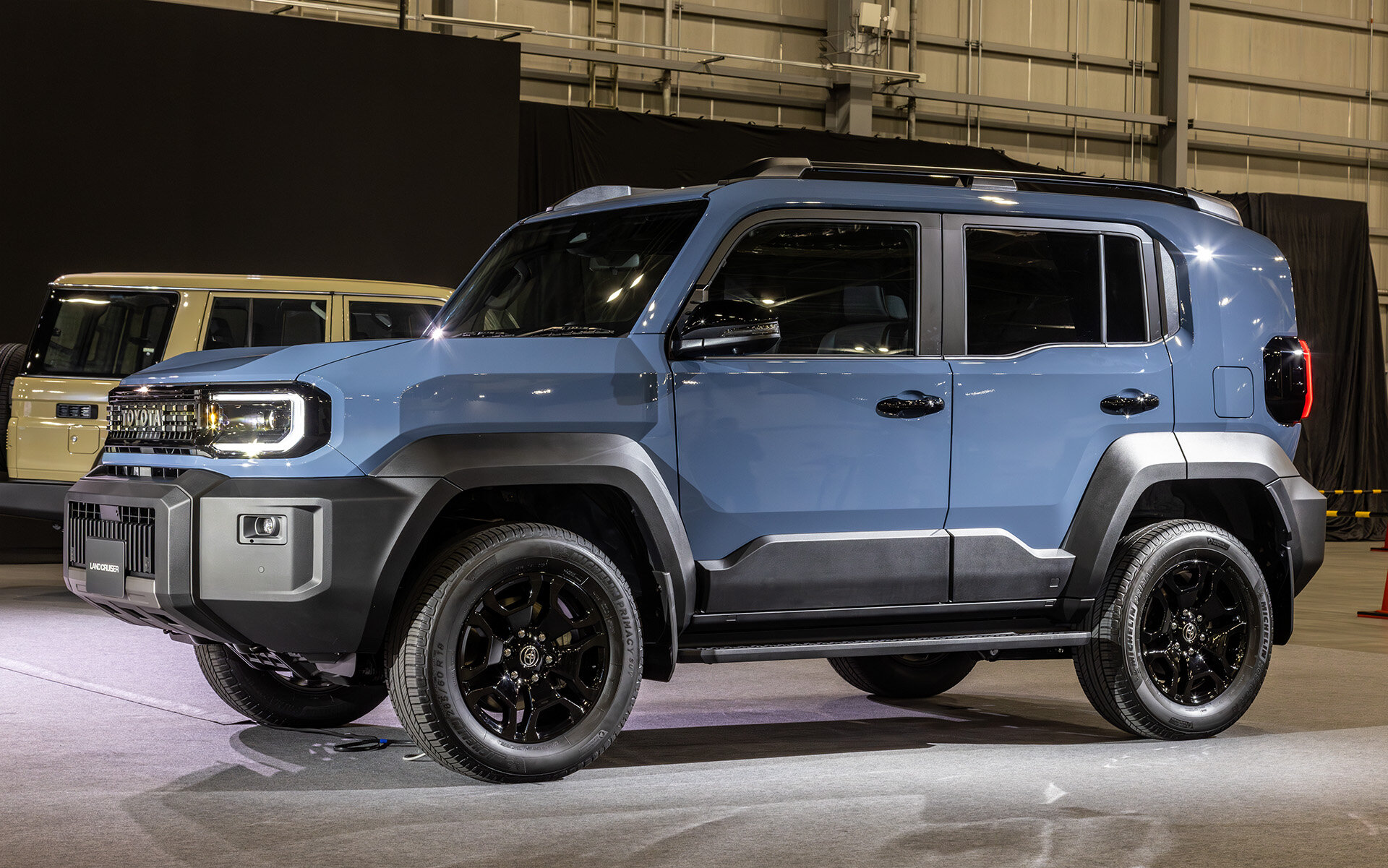
Gymkhana in the spotlight: Toyota Land Cruiser FJ premiering
On October 21, Toyota officially unveiled its latest compact SUV, the Land Cruiser FJ, endearingly nicknamed the "baby Cruiser" by enthusiasts. This innovative model stands out with dimensions of 4575 mm in length, 1855 mm in width, and 1960 mm in height, featuring a wheelbase of 2580 mm. By comparison, the larger Land Cruiser J250 (Prado) exceeds it by 350 mm in length, 95 mm in width, and is 35 mm shorter.
Constructed on a sturdy ladder frame chassis, the FJ is built to endure harsh terrains. Its underpinning platform IMV0 shares roots with the Hilux pickup, Fortuner SUV, and Innova van.
Design-wise, the exterior maintains a rugged and robust aesthetic, drawing inspiration from the classic Land Cruiser lineage, including the enduring J70 model. Interestingly, the FJ's looks also draw comparisons to the Chinese iCaur/iCar V27, which equally embodies the spirit of a Cruiser.
The base variant of the Land Cruiser FJ is equipped with a 2.7-liter 4-cylinder gasoline engine (2TR-FE), delivering 163 hp and a torque of 246 Nm. Though precise weight details are yet to be disclosed, reports suggest that it's approximately 200 kg lighter than the Prado, therefore estimated at 2040 kg. The engine is paired exclusively with a 6-speed automatic transmission and features a part-time four-wheel drive system. The front axle can be manually engaged, equipped with a low-range gearbox and rear differential locking. The parking brake is mechanically actuated, featuring a conventional lever.
Technical specifics regarding approach and departure angles are currently not available, although rumors indicate that the departure angle might sit around 30 degrees. The rear axle utilizes a non-split design. Production of the Land Cruiser FJ will take place at Toyota's facility in Thailand, home to their Hilux manufacturing lines.